
Pre-outfitted tanks
Deeply committed in the decarbonisation and energy transition of the maritime sector and in line with the international regulations, GTT has developed tailor-made solutions to make LNG as fuel easy and more widely accessible.
LNG BlockTM, LNG Brick® and the exoskeleton are alternative construction solutions for shipyards to facilitate the integration of the GTT membrane tank in a vessel. These solutions are particularly adapted for yards with no particular knowledge on GTT membrane technologies as the tank can be delivered ready for integration in the ship, fully outfitted and tested.
LNG BlockTM
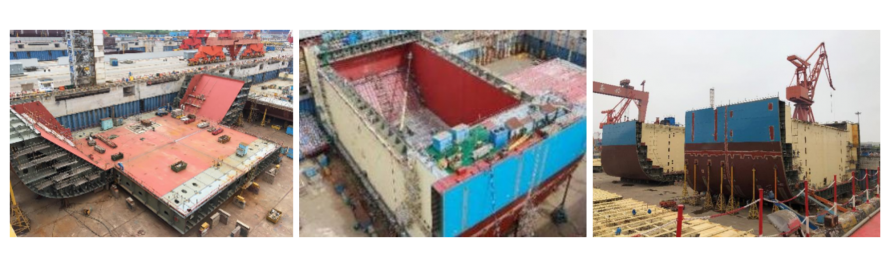
This concept consists in building the ship section incorporating the GTT tank (from 2 000 to 20 000 m3) in a specialised yard, then delivering it to the shipbuilding site, before assembling it with the rest of the vessel.
The LNG BlockTM structure is constructed and outfitted with the GTT containment system by a GTT licensee. The block can be equipped with the Fuel Gas Handling System, electrical networks, ventilation and piping network, if required by the client yard.
With this solution, many shipyards, whatever their location and background, can offer LNG tank solutions with:
- reduced cost and construction risk thanks to experienced membrane technology builders
- optimized delivery schedule thanks to a turnkey LNG solution
- savings in space & cargo with tailored LNG tanks

Various use cases of LNG BlockTM
|
New build projects mainly suitable for yards non-familiar with GTT technologies 
|
LNG conversion with jumboisation the additional cargo capacity can help monetize the whole retrofit operation 
|
Business case - CMA CGM containership new building project
In 2017, CMA CGM announced its decision to move to LNG powered container vessels. Delivered in 2020, these vessels were the first to be built with the LNG BlockTM concept.

Exoskeleton concept for LNG retrofit
The exoskeleton concept consists in a steel structure already fitted with GTT’s Mark III technology, which is ready to be integrated into the ship structure.
The exoskeleton can be adapted to small and medium tank size (< 12 000 m3; limited by lifting and transport capacity) and is most suitable to projects with specific construction constraints where LNG BlockTM and in situ construction would not be adapted.
Business case - Hapag Loyd retrofit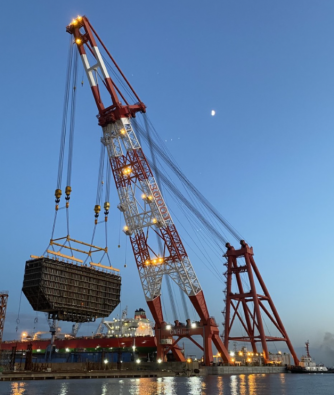
In 2021, the exoskeleton solution was chosen by Hapag Loyd to retrofit the first large-scale container vessel. It was the pilot project of Hapag Lloyd for the LNG fuel conversion of their series of LNG-ready container vessels.
The 15.000 TEU container vessel, named Brussels Express, was converted in HRDD yard, in China, and is now fitted with a 6,700 m3 LNG tank, whose structure was pre-equipped with GTT’s Mark III cryogenic containment system.

LNG Brick® concept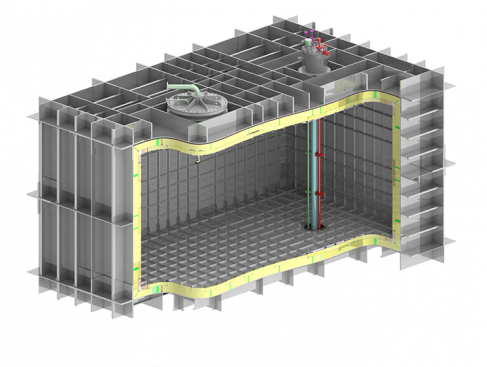
LNG Brick® is a cubic exoskeleton structure already fitted with GTT’s Mark III technology, which is ready to be integrated into the ship structure.
The LNG Brick® concept is mainly dedicated to vessels with high cargo/cabin constraints where its cubic geometry can save cabins or cargo space, such as for cruise ships, car carriers, and container feeders.
The LNG Brick® solution is suited for tank sizes from 300 to 3,000 m3. Its cubic shape allows it to adapt to the available space. Its standardized components reduce the number of references, simplify its design and therefore make LNG Brick® more competitive.
LNG Brick® is outfitted in a specialised yard, and then delivered to the shipbuilding site, before being integrated into the vessel.